Kimi K3 Is Here. 2.8 Trillion Parameters. What It Actually Means.
Moonshot AI just dropped Kimi K3 and the specs are hard to ignore. 2.8 trillion parameters, Mixture of Experts architecture, a 1 million token context window, and leaderboard numbers that are putting it in the same conversation as GPT 5.6. Here is what actually matters and what does not.
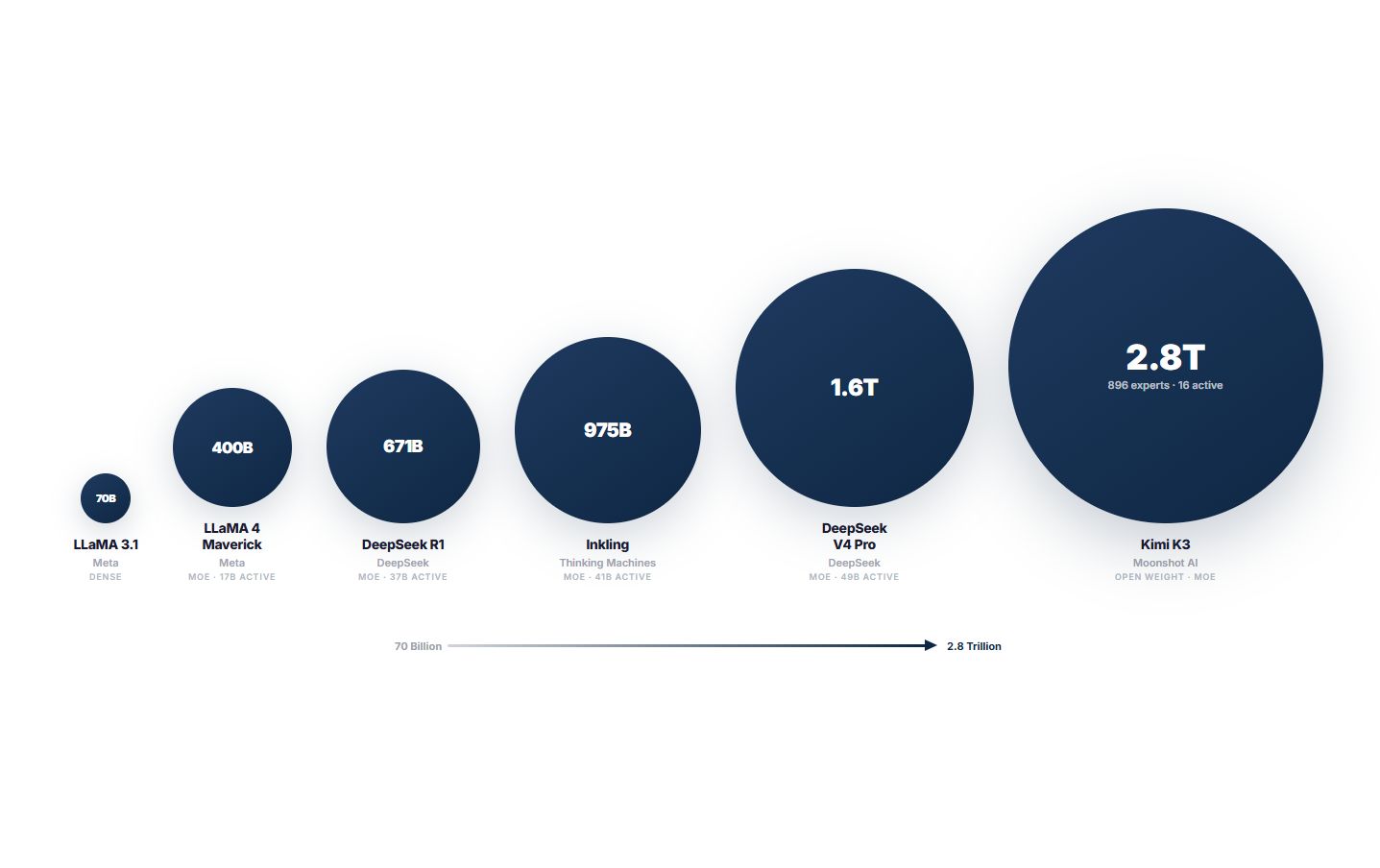
Moonshot AI just released Kimi K3, and the numbers are difficult to ignore. 2.8 trillion total parameters running on a Mixture of Experts architecture, a 1 million token native context window, and benchmark scores that are already trading with GPT 5.6 on the leaderboards. It has taken the top spot on LMArena's Frontend Code leaderboard and the AI community is moving fast to understand what this actually means in practice. Here is my breakdown of what matters, what does not, and what people are getting wrong.
The API Use Case Is Not What You Think The 1 million token context window is not a chat feature. It is an engineering tool. The practical implication of handling one million tokens natively is that you can feed it an entire codebase in a single prompt. Not a summarized version of a codebase, not a filtered selection of relevant files, but the actual thing: frontend components, backend architecture, database schemas, error logs, and dependency trees all at once. That changes what is possible for debugging complex, distributed systems. Cross-file bugs, state mismatches that span multiple services, and logic errors that only appear in the interaction between components have historically been extremely difficult to diagnose with AI tooling because the context window forced you to present a partial picture. With a million tokens available, you present the whole picture. The model reasons over the entire system rather than an approximation of it. The LMArena ranking reflects this. Frontend codebases are notoriously interconnected, and a model that can hold the full context of a modern framework project while tracking down a bug is genuinely more useful than one that needs the problem pre-digested for it.
The Commoditization of Frontier Intelligence The bigger story here is not Kimi K3 specifically. It is what Kimi K3 represents in the broader trajectory of the field. A model capable of competing with the most advanced proprietary systems in the world is now entering the open ecosystem. That sentence should be remarkable, and it is starting not to be, which is itself the most remarkable thing about it. The gap between what frontier labs can build and what the developer community can access is shrinking at a rate that nobody predicted two years ago. Reasoning capability that would have been locked behind an enterprise contract or simply unavailable to independent developers is now accessible through an API at a fraction of the cost of its proprietary equivalents. For developers working on serious applications outside of large organizations, this is a structural change, not just a product release.
The Reality Check on Open Weights I have seen a wave of posts claiming that a 1 million token context window signals the end of RAG systems. The logic being that if you can fit everything into a single prompt, you do not need retrieval anymore. This is worth addressing directly. The open weight version of Kimi K3 is a 2.8 trillion parameter model. Hosting that locally requires a GPU cluster that no independent developer, startup, or mid-sized team has access to. The math does not work. The real value of Kimi K3 for the vast majority of people building with it is not in the weights, it is in the API, which provides access to frontier level reasoning at a competitive price point without the infrastructure cost. RAG is not going away. For use cases involving private data, low latency requirements, cost sensitivity, or offline operation, retrieval augmented generation remains the correct architecture. A model you cannot host is not a replacement for a pipeline you can control.
What Comes Next Kimi K3 is a significant release, but the pace of the field means the window before the next comparable drop is measured in weeks, not months. The pattern is clear. Every major lab and several well-funded open source efforts are converging on the same capability frontier, and they are converging fast. What matters more than any individual model release is the structural shift underway: frontier reasoning capability is becoming a commodity input rather than a competitive moat. The interesting engineering question is no longer whether you can access a capable model. It is what you build with access to one, how you deploy it reliably, how you constrain its outputs for your specific use case, and how you make its behavior verifiable in the systems you are building around it. That is where the real work is.