The Democratization of Physical AI: Why the Tools Are Finally Ready
We are living in the most accessible era of Physical AI development. From NVIDIA NIMs and NeMo Guardrails to Isaac Sim, ROS 2, and open foundation models, the tooling that once required an enterprise infrastructure team is now available to independent developers. Here is why that matters and where the next bottleneck lies.
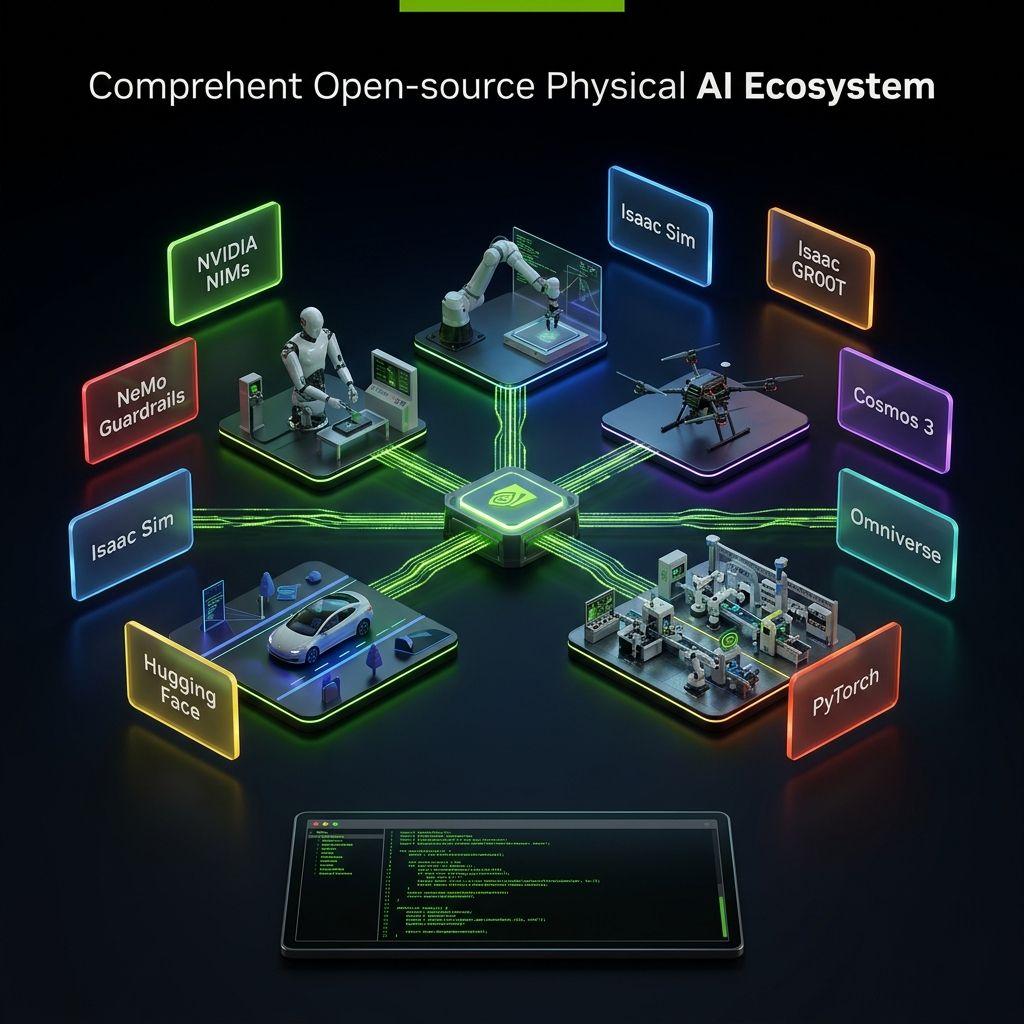
We are living in the most accessible era of Physical AI development, and most people do not even realize it yet. Physical AI is no longer locked behind enterprise walls. We are at a genuine inflection point right now where the boundary between research artifacts and deployable physical systems is dissolving. Look at what is available to independent developers today: NVIDIA NIMs provide access to frontier vision and reasoning models through cloud microservices. NeMo Guardrails is fully open source under the Apache 2.0 license for deterministic safety enforcement. Isaac Sim and Isaac Lab provide open multi physics simulation environments for large scale reinforcement learning. Isaac GR00T offers open foundation models for humanoid robotics, while Cosmos 3 is open under the Linux Foundation OpenMDW license for world modeling. Omniverse is accessible for digital twin simulation to real transfer. Complementing this stack is ROS 2 as the open source robotics middleware standard, Google DeepMind MuJoCo for contact rich physics simulation, and Hugging Face, LeRobot, and PyTorch unifying the ecosystem.
Two years ago, stitching even two of these frameworks together required a dedicated infrastructure team. Today, the integration barrier has dropped significantly. I recently open sourced two projects built natively on this stack: First, FARSIX, a deterministic Multi Agent Cognitive Orchestrator. It implements a Directed Acyclic Graph pipeline that routes mission contexts through specialized NIM agents. NeMo Guardrails operates as a Dual Model Semantic Auditor where an 8B model audits the output of a 70B model using Colang safety rules, physically intercepting the execution pipeline if hallucinations or violations occur. It includes asynchronous event driven architecture, automatic failure checkpoints, and a skill library for few shot conditioning. Second, SafeVLA, a real time edge cloud perception pipeline running local YOLOv4 tiny detection cross validated against NVIDIA NIM cloud vision reasoning to identify semantic and spatial inconsistencies live.
The Hardware Reality Check Even with these incredible tools, a structural reality remains: most of these simulation and inference stacks still demand high specification local compute to run smoothly. For developers in regions where high end hardware access is constrained, or for students operating on mid range laptops, the entry barrier remains real. Running complex physics simulation alongside multi gigabyte model weights requires substantial GPU memory and unified compute bandwidth. The next major breakthrough in Physical AI development cannot only be larger foundation models. It has to be optimizing these software stacks for lower spec hardware, improving quantization efficiency, and enabling lightweight simulation to real deployment on accessible devices.
The Tools Are Here. Let Us Keep Building. Whether you are building in robotics, multirotor drones, autonomous vehicles, or industrial factory automation, there has never been a better time to start shipping software. The open ecosystem has given independent builders access to capabilities that were unimaginable a few years ago. The tools are ready. The open source community is accelerating. Let us keep building.